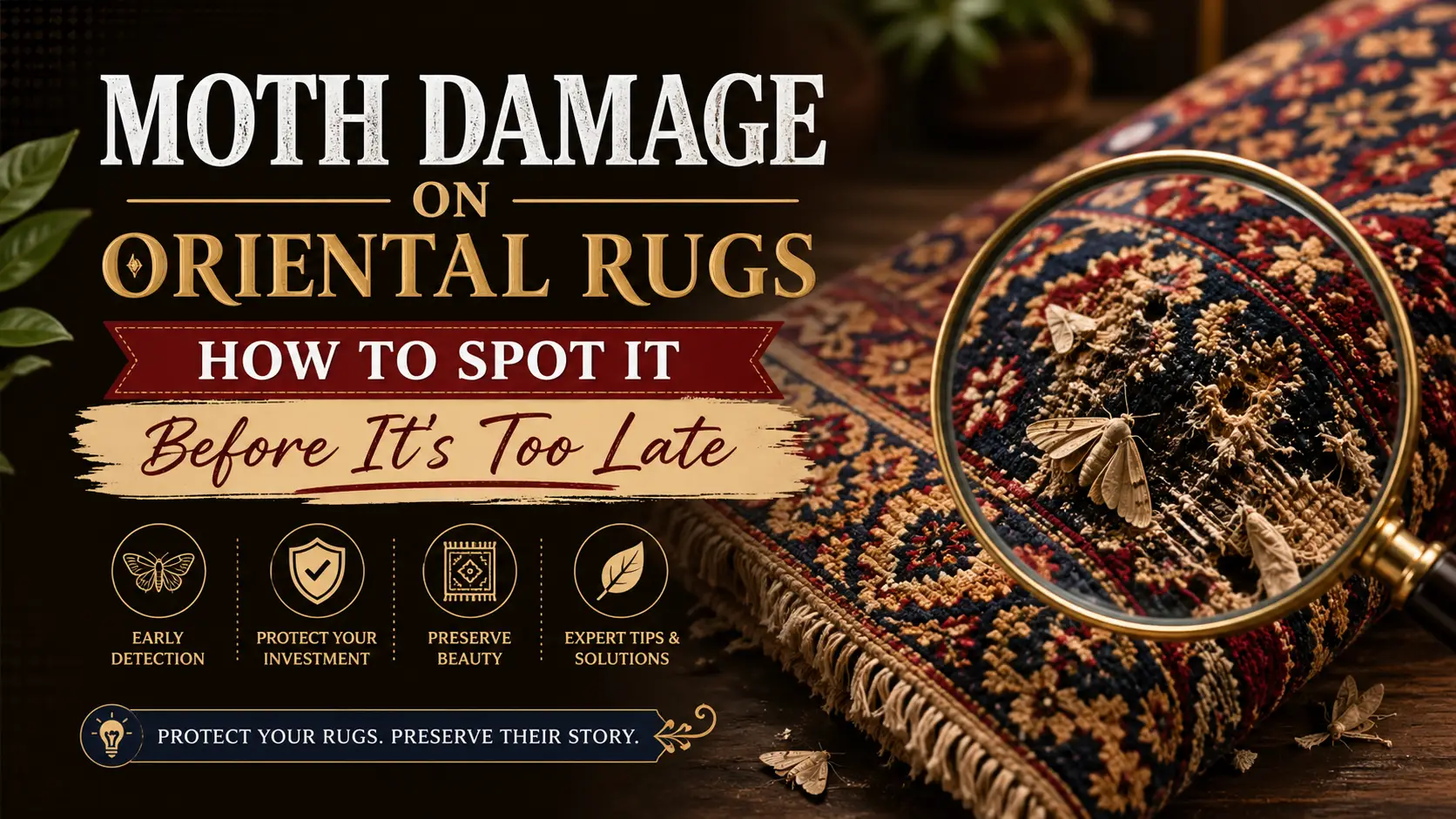
Moth damage repair for oriental rugs refers to the professional restoration of wool and silk rugs damaged by carpet moth larvae. Key steps include treating active infestations, re-weaving missing pile, repairing frayed foundations, and restoring color. Early detection — thinning pile, bare patches, or webbing — is critical to saving the rug.
You flip over a corner of your cherished Persian rug and see something that stops you cold — bare patches, a thin dusty web, and what looks like tiny grain-like specks scattered underneath. Your stomach drops.
Moth damage is one of the most destructive things that can happen to an oriental rug. The worst part? It usually happens in the dark, under furniture, in storage — completely out of sight. By the time most Dallas homeowners notice it, the larvae have already eaten through months of irreplaceable wool pile.
The good news: if you catch it early enough, professional moth damage repair for oriental rugs can save your investment. This guide will show you exactly what to look for, what causes it, and what to do about it right now.
Table of Contents
- What Actually Causes Moth Damage in Oriental Rugs?
- 7 Early Warning Signs You Must Never Ignore
- Where Moths Hide Most in Dallas Homes
- DIY Treatments vs. Professional Moth Damage Repair
- What the Repair Process Actually Looks Like
- How to Protect Your Oriental Rugs Going Forward
- Frequently Asked Questions
What Actually Causes Moth Damage in Oriental Rugs?
Here's the thing most people don't realize — it's not the adult moth that destroys your rug. It's the larvae.
Female carpet moths (Tineola bisselliella) lay eggs directly in the pile of wool or silk rugs. When the eggs hatch, the larvae feed on keratin — the natural protein found in wool fibers. They can chew through an entire section of pile before you ever see a single adult moth flying around your room.
Oriental rugs are prime targets because they're made of natural fibers — wool, silk, cotton. Synthetic rugs are mostly immune. That's why your antique Persian, Turkish, or hand-knotted Afghan rug is always more at risk than a machine-made polyester carpet.
Why Dallas Homes Are Particularly Vulnerable
Dallas has warm, humid summers. Moths thrive in these conditions. Add central air-conditioning that creates cool, undisturbed zones under furniture — and you've got the perfect breeding ground. Many of the moth damage cases we see at Artisan Rug Care's Dallas repair shop come from rugs stored in garages, closets, or shaded dining rooms where nobody checks underneath.
7 Early Warning Signs You Must Never Ignore
Catching moth damage early is everything. A rug with a small affected area can often be fully restored. One with widespread larval activity may require much more intensive work — and in extreme cases, sections may be beyond repair.
Here's what to look for:
- Thinning pile in one area — If one section of your rug suddenly looks flatter or sparser than the rest, larvae may have eaten through the wool knots. Run your fingers across the surface. Healthy oriental rug pile should feel dense and even.
- Bare patches or foundation showing — When you can see the cotton or jute warp and weft threads through the pile, that's active or past moth feeding. The pile is gone. This requires re-weaving by a professional.
- White or grayish webbing on the back — Carpet moth larvae spin a silky tunnel or casing to protect themselves as they feed. Flip your rug over and look for cottony webbing, especially near the edges.
- Tiny pellet-like droppings (frass) — Small brown or tan specks that look like coarse sand or grain. These are larval droppings and a clear sign of active or recent feeding.
- Shed larval casings — Translucent, hollow shells that look like tiny grains of rice. These are the "skins" larvae leave behind as they grow.
- Adult moths flying indoors in spring/summer — Adult carpet moths are small, golden-buff colored, and tend to flutter low near the floor rather than fly toward light (unlike common clothes moths). Seeing them near a rug is a red alert.
- Edges and corners look frayed or chewed — Moths often start at the edges and work inward. Unusual fraying — especially asymmetric — on your rug's border is a warning sign worth investigating.
- Check for thinning or absent pile in one area
- Flip the rug — look for silky webbing on the back
- Look for tiny frass (droppings) or shed larval casings
- Inspect edges for unusual, asymmetric fraying
- Watch for small golden moths flying low near the rug
Where Moths Hide Most in Dallas Homes
Carpet moths don't like foot traffic, light, or disturbance. They hide where it's dark, still, and undisturbed. These are the highest-risk locations in most Dallas homes:
- Under heavy furniture — Sofas, beds, and dining tables that rarely move. This is the #1 place we find damage.
- Rug storage — Rolled-up rugs in closets, garages, or climate-controlled storage are extremely vulnerable. Moths can infest a stored rug within a single season.
- Corners and edges — These low-traffic areas rarely get vacuumed thoroughly. Perfect hiding spots.
- Wall-hung rugs — Beautiful on display, but the back is never disturbed. Moths love the back side of decorative pieces.
- Rooms that stay dark — Guest bedrooms, home offices, or formal dining rooms used rarely in Dallas summers.
The rule of thumb: any area of your rug that doesn't get vacuumed or walked on at least once a week should be checked regularly.
Think you may have moth damage on your oriental rug?
Don't wait — the longer you wait, the more pile is lost. Artisan Rug Care offers free pickup and inspection in Dallas, TX.
DIY Treatments vs. Professional Moth Damage Repair
There's a lot of advice online about killing carpet moths. Some of it works — for stopping an active infestation. But here's what no home remedy can do: restore missing pile, re-weave damaged foundation, or color-match the repair to the original rug.
What DIY Can Do
- Kill live adult moths and larvae using freezing (72 hours at 0°F), dry heat, or moth-specific insecticide sprays
- Remove eggs with a thorough vacuuming on both sides of the rug
- Prevent re-infestation with cedar, lavender sachets, or moth traps
What Only a Professional Can Do
- Re-pile weaving — Replacing individual knots in hand-knotted oriental rugs using matching wool or silk
- Foundation repair — Fixing damaged warp and weft threads underneath the pile
- Color matching and restoration — Matching original dyes — especially vegetable-dyed antique pieces — requires expert skill
- Full infestation treatment — Professional cleaning removes all larval debris, eggs, and frass embedded deep in the pile
- Structural assessment — Determining whether damage is isolated or has spread to the rug's inner structure
Attempting to re-weave a hand-knotted rug without training will almost always make the damage more visible and harder to fix later. If you see any of the warning signs above, the smart move is to get a professional evaluation first.
What the Moth Damage Repair Process Actually Looks Like
For those who have never had their rugs repaired by a professional, the whole process might be pretty mysterious to them. When it comes to repairing moth damage, the team at Artisan Rug Care in Dallas goes step by step in a very orderly way that results in excellent restoration.
- Full inspection and damage mapping — The carpet undergoes a thorough check from both sides in suitable lighting conditions. The expert records every damaged spot, assesses the condition of the warp threads, and determines the degree of pile loss.
- Infestation treatment and deep cleaning — Before any repair begins, the rug is treated to eliminate any remaining eggs or larvae. Then, it undergoes a professional washing process to remove frass, larval casings, and debris embedded in the pile. See how this works with our oriental rug cleaning process.
- Foundation stabilization — Damaged warp or weft threads are either fixed or replaced in order to create a firm foundation for re-weaving.Pile re-weaving, Single knots are tied with wool or silk that match the original material and color of the rug.
- Pile re-weaving — Individual knots are tied using wool or silk that matches the rug's original material and color. This is painstaking, hand-done work — the same technique used by the original rug weavers.
- Color blending and touch-up — The repaired area is treated to blend as naturally as possible with the surrounding pile. On antique rugs with oxidized colors, this requires careful dye work.
- Final wash and finishing — The rug is washed again, dried in a controlled environment, and finished to restore its natural luster and texture.
The result, on well-preserved rugs caught early, is often nearly invisible to the eye. The earlier moth damage is caught, the better the restoration outcome.
How Long Does Moth Damage Repair Take?
It depends heavily on the extent of damage. A small, localized area may take 5–10 business days. Extensive pile loss across multiple sections can take 3–6 weeks for a proper hand-repair. Rush services are sometimes available for smaller repairs — call to ask.
| Damage Level | Typical Repair Time | Repair Approach |
|---|---|---|
| Minor (small bare patches) | 5–10 days | Localized re-pile weaving |
| Moderate (multiple areas) | 2–4 weeks | Full cleaning + multi-area re-weaving |
| Severe (large sections lost) | 4–8 weeks | Foundation repair + extensive re-pile |
| Critical (structural damage) | Custom quote | Full restoration assessment needed |
How to Protect Your Oriental Rugs Going Forward
Once you've dealt with a moth infestation — or want to prevent your first one — these habits make a real difference:
- Vacuum regularly, including the back. Flip your rugs 2–3 times per year and vacuum both sides thoroughly. Pay special attention to edges and corners.
- Move furniture occasionally. Shift sofas and tables slightly every few months to expose protected pile to light and air circulation.
- Use cedar or lavender in storage. These natural deterrents don't kill larvae, but they discourage egg-laying. Replace them every 6 months.
- Store rugs correctly. Clean the rug professionally before storing. Wrap in acid-free paper or breathable cotton — never plastic, which traps moisture. Store in a cool, dry location.
- Schedule professional cleaning annually. A thorough professional wash removes eggs and larvae before they establish. Professional rug cleaning in Dallas is the single best preventive measure you can take.
- Inspect high-risk areas every season. Make it a habit — spring and fall — to check under furniture and examine rug backs for any of the warning signs above.
- Act immediately at the first sign. If you spot anything suspicious, don't wait. Larvae double their feeding activity in warm months.
Dallas's Most Trusted Oriental Rug Repair Specialists
From tiny bare patches to severe moth infestation damage — Artisan Rug Care restores hand-knotted oriental rugs with expert precision.
Free pickup & delivery across Dallas, TX.
👉 Get a Free Moth Damage Assessment →People Also Ask About Moth Damage Repair on Oriental Rugs
What does moth damage look like on an oriental rug?
Moth damage typically appears as thinning or completely bare patches where the wool pile has been eaten away. You may also see silky webbing on the back of the rug, tiny brown droppings (frass), or shed larval casings that look like hollow grains of rice. Edge fraying that looks asymmetric or sudden is also a warning sign.
What is moth damage on a rug?
Moth damage on a rug refers to the harm done when carpet moth larvae (Tineola bisselliella) consume the keratin protein found in the natural wool or silk of the pile. The larvae continue to gnaw the twisted fibers and create bare spots in the pile and, in some cases, even damage the underlying structural warp threads. Adult moths are generally harmless when it comes to damaging rugs; it's only their larvae that cause the damage.
How can I get rid of moths in my oriental rug? If you want to kill the moths that have already laid eggs in your rug, the first thing to do is to thoroughly vacuum both sides of your rug including the back and underpad. A good way to kill the moth larvae is to freeze the rug for 72 hours at 0°F or you can also use moth spray for natural fibers. However, expert cleaning is the best method as it can get rid of eggs, larvae and dirt from deep within the pile that even home vacuuming cannot reach. What is the average cost of repairing moth damage on oriental rugs? The price of repair depends on the size of the damaged area, the density of the knots, and the type of fiber of the rug. Small area repairs may start at $150, $300. Large-scale re-weaving across several sections or dense silk rugs can be much more costly. Besides, most Dallas rug repair shops like Artisan Rug Care also do offer free assessments and quotes even before you commit.
Can moth-damaged oriental rugs be fully restored?
Yes, in most cases — especially when the damage is caught early. Small to moderate areas of pile loss can be re-woven by hand to closely match the original. Even large damaged sections can often be restored, though very severe structural damage (where warp threads are also destroyed) may result in some visible evidence of repair on close inspection.
What is the best way to prevent moths in oriental rugs in Dallas?
Regular vacuuming on both sides is the most effective prevention. Annual professional cleaning removes eggs before they hatch. Store rugs wrapped in breathable cotton — not plastic — with cedar blocks, and always clean before storing. Inspect high-risk spots like under furniture and corners at least seasonally.
How long does professional moth damage repair take in Dallas?
Minor repairs typically take 5–10 business days. Moderate to severe damage can take 2–8 weeks depending on the scope of re-weaving required. Artisan Rug Care in Dallas provides free pickup, so you won't need to haul your rug in yourself. Timeline estimates are provided after the initial damage assessment.
Frequently Asked Questions
Do carpet moths only damage wool rugs?
Carpet moth larvae primarily target natural protein fibers — wool, silk, and cashmere. Cotton and jute (used in rug foundations) are less affected. Synthetic rugs made of nylon, polyester, or polypropylene are essentially immune. However, if synthetic rugs are blended with wool or have organic debris embedded in them, limited feeding can occur.
Can I store my oriental rug in a plastic bag to keep moths out?
This is actually not recommended. Plastic traps moisture, which can lead to mold, mildew, and dye damage — potentially more destructive than moths. Use clean, breathable cotton muslin wrap or acid-free tissue paper. Keep in a cool, dry place with cedar blocks nearby to help keep pests away.
Does professional rug cleaning kill carpet moth eggs?
Yes. The submersion washing process used in professional oriental rug cleaning — combined with the mechanical agitation and pH-balanced solutions — destroys moth eggs, larvae, and frass embedded deep in the pile. This is why annual professional cleaning is the single most effective preventive measure for Dallas homeowners with wool rugs.
What is frass and why does it matter for moth damage?
Frass is the technical term for larval droppings — small brown or tan granules that look like coarse sand scattered on the back of the rug. Finding frass is a definitive sign of moth larval activity. It's also slightly acidic and, over time, can damage the wool fibers it rests on if not cleaned out professionally.
How do I know if my oriental rug has active moths vs. old damage?
Active infestations typically show live larvae (creamy-white with brown heads, 1–5mm long), fresh webbing, and new frass that looks clean and light-colored. Old damage will show darkened or degraded frass, no live larvae, and fraying that has settled and stiffened. Either way, professional assessment is recommended dormant eggs can re-activate in warm conditions.
Are some oriental rugs more at risk for moth damage than others?
Yes. Rugs with higher wool content, finer knot density, and older vegetable-based dyes tend to attract more larval activity — the natural lanolin in undyed or lightly dyed wool is especially attractive. Antique rugs, Persian rugs, and Turkish Oushak rugs are high-risk. Heavily soiled or sweat-dampened rugs are also more attractive to egg-laying females.
Does Artisan Rug Care offer moth damage repair for rugs in Dallas?
Yes. Artisan Rug Care specializes in professional moth damage repair for oriental and Persian rugs throughout Dallas, TX and the greater DFW area. Services include infestation treatment, professional cleaning, re-pile weaving, foundation repair, and color restoration. Free pickup and delivery is available. Call (469) 387-6777 to schedule an assessment.
No comments yet. Be the first!